

Medical Video Remote Interpreting vs. In-Person: Build a Hybrid Language Access Program for 2027
Healthcare organizations face an important decision in 2027: how to deliver fast, accurate, and compliant language access across every care setting. Medical video remote interpreting (VRI) is the primary modality for on-demand encounters, while in-person interpreting remains essential for high-stakes clinical conversations. Over-the-phone interpreting (OPI) is a cost-effective option, ideal for low medical complexity encounters or when access to rare languages is required.
The right approach is usually a hybrid strategy that deploys each modality based on the needs of the patient and encounter, and also honors the patient’s preference when possible. This guide explores the differences between VRI, OPI, and in-person interpreting and how healthcare organizations can determine which modality is appropriate for different situations.
What Is Medical Video Remote Interpreting?
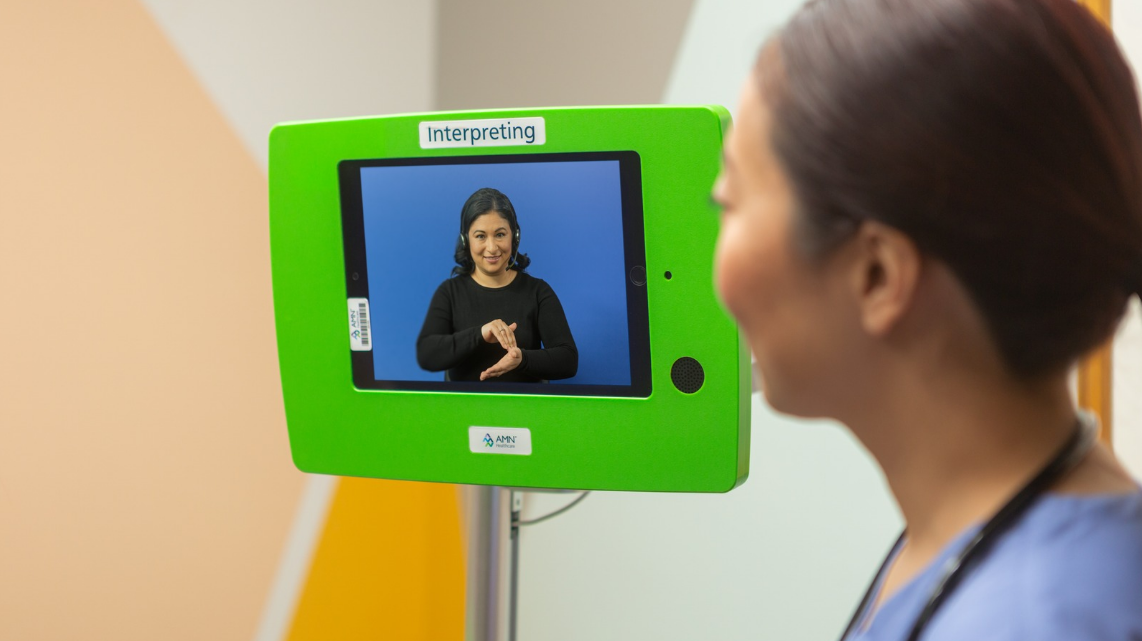
Medical video remote interpreting (VRI) is an on-demand language access service that connects patients and healthcare providers with a qualified interpreter via secure, live video. Unlike phone interpreting, VRI restores visual communication, including facial expressions, gestures, and body language, enabling more accurate and empathetic clinical encounters.
In practice, a clinician launches a video session from a tablet, workstation, or mobile device within the clinical environment. The VRI platform connects to a qualified medical interpreter, often in seconds, using low-latency video and audio technology that minimizes lag. The interpreter appears on screen, sees both the patient and provider, and facilitates the conversation in real time. Modern healthcare VRI can also be embedded in EHR systems, enabling one-click session launch directly from the patient chart.
VRI can provide the speed of remote interpreting while adding the visual context that phone interpreting cannot provide. Visual cues, such as a grimace of pain, a nod of understanding, or the hand movements essential to American Sign Language, can provide important context during a clinical encounter.
Differences Between VRI, In-Person, and Over-the-Phone Interpreting
The three primary medical interpreting modalities — video remote interpreting (VRI), over-the-phone interpreting (OPI), and in-person interpreting — differ in speed of access, visual communication capability, cost structure, and suitability for clinical encounters. The right choice depends on encounter type, patient needs, and operational constraints.
| Feature | VRI | OPI | In-person |
|---|---|---|---|
| Visual communication | ✅ Full video | ❌ Audio only | ✅ In-person |
| Typical connection time | On-demand, typically available within seconds | On-demand, typically available within seconds | Scheduled in advance; availability varies by location and language |
| ASL support | ✅ Available | ❌ Not viable | ✅ Available |
| Cost model | Per-minute / per-session | Per-minute / per session | Hourly minimums + travel |
| Best suited for | ED, walk-in, telehealth, ASL | Brief routine calls, triage, and access to rare languages | Complex consent, mental health, end-of-life |
| Technology requirements | Stable internet, camera, secure platform | Phone line or VoIP | None |
| Clinician preference (research) | Moderate–High | Lower | Highest |
Benefits of Video Remote Interpreting
VRI offers several advantages for healthcare organizations, particularly when visual communication and timely access to an interpreter are important. Unlike phone-only interpreting, VRI allows patients and providers to communicate through live video while providing on-demand access without the scheduling requirements of in-person interpreting.
- Rapid access: VRI can connect users with qualified interpreters quickly, making it an effective modality for unplanned encounters. In emergency departments, this speed supports patient safety.
- Visual communication: VRI restores the facial expressions, gestures, and body language that phone interpreting removes. This channel is especially valuable in sensitive appointments, when a patient’s nonverbal communication can provide important context.
- Cost efficiency: VRI reduces travel expenses, waiting time, and the minimum hourly fees tied to onsite dispatch.
- ASL access: Video provides a visual channel for American Sign Language (ASL) interpreting, allowing Deaf and hard-of-hearing patients to access qualified ASL interpreters remotely when an in-person interpreter is not available or when VRI is otherwise appropriate.
- Improved patient flow: On-demand video interpreting can help reduce delays associated with waiting for an onsite interpreter, supporting more efficient clinical workflows.
- Scalability across care settings: VRI is deployed across emergency departments, ambulatory clinics, inpatient floors, pharmacies, discharge planning, and call centers. In the ED, it serves as the primary modality when speed is critical. In ambulatory settings, it handles routine follow-ups without scheduling delays. At discharge, it helps ensure patients understand medication instructions and follow-up plans. In call centers, VRI supplements OPI when ASL or visual context is needed.
For hospitals, FQHCs, and health systems managing thousands of limited English proficiency (LEP) encounters monthly, VRI's combination of speed, visual fidelity, and cost control makes it a central component of a language access program.
Advantages of In-Person Medical Interpreting
In-person interpreting can be valuable for clinical encounters that require deep rapport, nuanced communication, and sustained attention, including informed consent for complex procedures, serious diagnoses, mental health evaluations, and end-of-life discussions.
- Rapport and trust: Physical presence allows the interpreter to read the full room dynamic, manage turn-taking naturally, and provide emotional support.
- Accuracy in complex encounters: Onsite interpreting is often preferred for informed consent, serious diagnoses, end-of-life care, and mental health sessions where the stakes of miscommunication are highest and conversations may last an hour or more.
- No technology dependency: In-person interpreting can be useful when bandwidth is unreliable, camera quality is inadequate, or the physical environment makes remote technology impractical.
In-person interpreting also has limitations. Scheduling lead times can vary, especially for less common languages, and geographic availability can affect access in rural and underserved areas. Per-encounter costs may also be higher due to travel time and mileage. Making in-person interpreting less practical for some unplanned encounters.
These realities are why AMN Healthcare positions its in-person interpreter network as one component of a broader hybrid solution, not a standalone offering. The aim is to deploy in-person interpreters where they add the most clinical value, while VRI and OPI handle volume and urgency that onsite staffing alone cannot address.
Ideal Modality by Care Setting
| Care setting | Primary modality | When to escalate |
|---|---|---|
| Emergency department | VRI, IPI when possible | Trauma, psychiatric holds → in-person |
| Inpatient / bedside | VRI, IPI when possible | Complex care conferences, goals-of-care → in-person |
| Ambulatory / outpatient | VRI, IPI when possible | New-patient intakes with complex histories → in-person |
| Pharmacy | VRI or OPI for medication counseling | — |
| Discharge | VRI for standard instructions | Complex discharge with multiple follow-up needs → in-person |
| Call center / scheduling | OPI as primary | ASL needed → VRI |
| Telehealth | Virtual interpreting (interpreter joins platform) | Behavioral health → consider in-person if feasible |
Operational Considerations for VRI in Healthcare Settings
Successful VRI deployment depends on three operational pillars: Service Level Agreements (SLAs), technology integration, and regulatory compliance. Effective VRI requires secure software, specialized hardware, and stable internet connectivity. Lagging video or distorted audio can compromise medical diagnosis, making operational rigor essential to patient safety. AMN Healthcare emphasizes contractual SLAs, purpose-built hardware, and continuous monitoring as deployment elements.
Typical VRI Response Times and Service Level Agreements
Leading medical VRI providers, including AMN Healthcare, typically guarantee interpreter connection times of under 30 seconds for high-demand languages, with SLAs covering connection speed, encounter completion rates, interpreter qualification standards, and platform uptime.
When evaluating providers, insist on contractual connection-time guarantees rather than reported averages, which can mask inconsistency during peak hours. Ask for abandonment rate data, the percentage of sessions where the clinician disconnects before an interpreter joins, as a leading indicator of service reliability. AMN Healthcare publishes its SLA commitments and provides utilization dashboards that give language access coordinators real-time visibility into performance against those commitments.
Integration of VRI with Electronic Health Records and Telehealth Workflows
Modern VRI platforms integrate with electronic health records (EHRs) and telehealth systems via embedded widgets, single sign-on (SSO), and API connections. This allows clinicians to launch an interpreter session with one click directly from the patient chart or virtual visit workflow.
This embedded approach eliminates the friction of switching between systems, dialing separate phone numbers, or manually logging interpreter encounters. AMN Healthcare's VRI technology is designed to integrate with major EHR platforms and mobile devices, reducing workflow disruption and ensuring every interpreter encounter is documented.
For telehealth encounters, the workflow differs: the interpreter joins the virtual care session (Zoom, Teams, Amwell, or a proprietary platform) as a third participant rather than appearing on a separate bedside device. This approach allows the interpreter to participate directl in the existing video visit rather than requiring the patient or provider to manage a separate VRI device.
Selecting the Best Medical Interpreting Solution for Hospitals and Clinics
The best medical interpreting solution for a hospital or clinic is not a single modality but a partner that offers all three — VRI, OPI, and in-person — with the operational infrastructure, clinical specialization, and technology integration to deploy the right mode for every encounter.
Vendor Evaluation Checklist
| Evaluation criteria | What to look for |
|---|---|
| Language coverage | Broad language coverage across available modalities |
| Interpreter qualifications | Minimum interpreting experience, language proficiency testing issued by a third party (not the hiring language service provider), healthcare-specific training, and ongoing quality monitoring |
| Response time SLAs | Contractual connection-time guarantees, not just reported averages |
| Technology integration | EHR integration (Epic, Oracle Health), telehealth platform compatibility, mobile support, SSO |
| Compliance posture | HIPAA BAAs, Section 1557 compliance documentation, encryption standards, compliance reporting |
| Billing model | Price transparency on minimum charges |
| Scalability | Ability to handle volume surges (flu season, community health events, disaster response) |
| Reporting and analytics | Encounter data, language trends, cost-per-encounter, utilization dashboards |
| Healthcare specialization | Percentage of interpreters with medical training; experience serving hospitals, FQHCs, and health systems |
When evaluating providers, consider how well their services, technology, and operational support align with your organization's patient population and encounter needs. Reviewing historical utilization data can also help determine the right mix of VRI, OPI, and in-person interpreting.
Building a Hybrid Language Access Program for 2027
The optimal 2027 language access strategy is hybrid: a combination of VRI, in-person, and OPI interpreting based on the needs of the patient, encounter, and care setting.
Five-step implementation framework:
- Audit current language access utilization. Analyze encounter volume by language, modality, care setting, and cost. Identify where delays, gaps, or overreliance on a single modality create risk or inefficiency.
- Define triage criteria. Establish clear, department-specific guidelines for when staff should use VRI, OPI, or in-person interpreting based on the decision tree. Post quick-reference guides in clinical areas.
- Invest in platform reliability. Ensure network infrastructure supports high-quality video. Deploy redundant connectivity in high-volume areas, such as the ED and labor and delivery. Test equipment regularly and maintain backup devices.
- Train clinical staff. Provide hands-on training for VRI device use, interpreter request workflows, and troubleshooting. Remote interpreters face unique workflow challenges in fast-paced medical environments, and staff awareness of these dynamics improves collaboration and encounter quality.
- Monitor, measure, optimize. Track response times, encounter completion rates, patient satisfaction scores, and cost-per-encounter. Adjust the modality mix quarterly based on data.
Choosing the right modality for each situation also protects the quality of the interpreter experience. Research has found that video was distracting for some users due to eye-contact challenges, setup time, and technical issues, while providers found that phone interpreting was distracting because of poor audio and lack of a visual channel. A hybrid program that matches modality to encounter type mitigates these friction points for patients, providers, and interpreters alike.
Ready to build your 2027 hybrid language access program? Explore AMN Healthcare's language services to see how a single partner can provide VRI, OPI, and in-person interpreting with the clinical depth, technology integration, and compliance infrastructure your organization needs.
Frequently Asked Questions
When should hospitals choose in-person interpreting over VRI?
Hospitals should choose in-person interpreting for high-stakes clinical encounters such as informed consent for complex procedures, serious diagnoses, mental health evaluations, and end-of-life discussions — situations where physical presence, direct eye contact, and sustained rapport are essential for patient understanding and safety. In-person interpreting is also appropriate when technology constraints, such as unreliable internet, inadequate camera positioning, or clinical environments that preclude device placement, make VRI impractical.
Can VRI fully replace in-person interpreting in clinical care?
VRI cannot fully replace in-person interpreting. While VRI is the most practical on-demand solution for speed, cost efficiency, and certain instances of ASL access, in-person interpreting remains the standard for complex, emotionally sensitive, or high-stakes encounters where the interpreter's physical presence improves communication accuracy and patient trust. The most effective approach is a hybrid model that deploys each modality where it performs best.
Is VRI suitable for Deaf and hard-of-hearing patients?
Yes. VRI is an important modality for Deaf and hard-of-hearing patients because it provides remote access to qualified American Sign Language (ASL) interpreters via live video. Effective video remote interpreting requires a stable, high-speed network connection and video displays that are large enough to clearly show the interpreter's face, arms, hands, and fingers. In-person ASL interpreting is preferred when available, particularly for extended or complex encounters, but VRI ensures timely access when an onsite ASL interpreter cannot be scheduled.
How do healthcare providers ensure high-quality VRI delivery?
Providers ensure high-quality VRI by maintaining reliable high-speed internet with redundant connectivity in high-volume areas, positioning the screen so the interpreter's face, hands, and fingers are clearly visible, using medically qualified interpreters, and training staff on equipment use and troubleshooting protocols. Contractual SLAs covering connection time, platform uptime, and encounter completion rates provide accountability.
Can hospitals combine VRI and in-person interpreting for optimal coverage?
Yes. Most leading healthcare organizations use a hybrid approach, deploying VRI for urgent, unplanned, or routine encounters and scheduling in-person interpreters for complex, high-stakes, or emotionally sensitive visits. OPI supplements both modalities for brief exchanges and rare languages. This hybrid model balances speed, cost efficiency, and communication quality across care settings and is the strategy AMN Healthcare recommends for modern language access programs.