

Webinar: How Language Services Drive Better Outcomes and Stronger Margins
You know the pressure well. Operating costs keep climbing, and every line item faces scrutiny. Language services often land in that crosshair, treated as a back-office expense rather than what they truly are: a direct lever on patient access, throughput, and clinical quality.
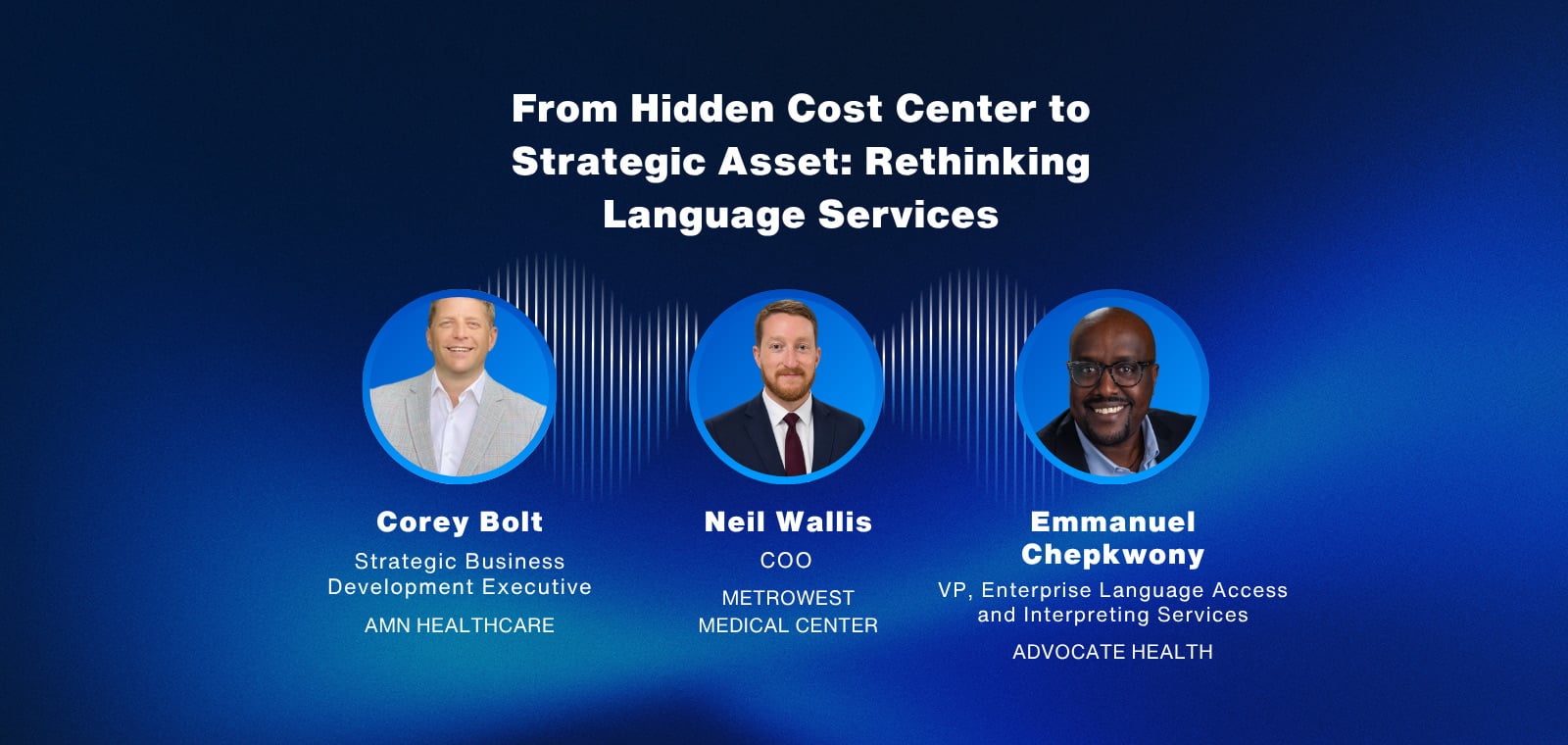
On June 23, 2026, Becker's Healthcare hosted a panel that reframed the conversation entirely. Titled "From Hidden Cost Center to Strategic Asset: Rethinking Language Services," the session brought together three leaders with hands-on experience:
- Neil Wallis, Chief Operating Officer at MetroWest Medical Center
- Emmanuel Chepkwony, Vice President of Enterprise Language Access and Interpreting Services at Advocate Health
- Corey Bolt, Strategic Business Development Executive at AMN Healthcare
Together, they made the case that language access belongs in the DNA of your organization, not bolted on as an afterthought. Here is what they shared, and what it means for your teams and your patients.
Operational Efficiency: Real Numbers, Real Throughput
When you place interpretation directly inside the clinical workflow, the operational gains show fast. MetroWest Medical Center proved the point by putting interpreter devices in every emergency department room.
- Walkout rates dropped from 10% to 1.4%, retaining 770 to 800 patients per quarter
- ED median length of stay fell from 244 minutes to 171 minutes, with their goal being just under 170 minutes
These improvements mean shorter wait times for patients while helping clinical teams move care forward more efficiently.
Advocate Health shared a different perspective on operational efficient: managing more than 4 million interactions each year using what Chepkwony called a "modality matrix," which is a model that matches the right interpretation method to each visit type.
- Over-the-phone interpretation (OPI), video remote interpretation (VRI), and in-person services, routed by visit type
- Automatic backup triggers so no patient waits when one channel is busy
- Interpreter applications loaded onto providers' own mobile devices, ending the daily scramble to transport physical iPads during rounding
The common thread across both organizations is thoughtful integration of language services into clinical workflows. The result is efficiency: less friction for clinicians and faster connections for patients.
Closing Gaps for Patient Experience and Communication
Communication gaps create real clinical risks. The panelists offered practical ways to close these gaps. Printing discharge summaries and After Visit Summaries in the patient's primary language helps prevent comprehension fallouts and supports care adherence after they leave your doors.
There is also a satisfaction nuance worth your attention. LEP and deaf or hard-of-hearing patients often report higher likelihood-to-recommend scores than English-speaking patients. Yet they score lower on "listen to me" and "help me understand." That gap is a place where the right intervention strengthens trust and quality together.
Community Demographics and the Business Impact of Language Access
Community demographics and language access are closely connected. As communities shift, Healthcare organizations must be prepared to meet the language needs of the patients they serve. The panel highlighted the demographic reality behind that challenge.
- Framingham, served by MetroWest, has a 45% non-English primary-speaking population, led by Portuguese and Spanish speakers
- Sudden regional influxes of immigrant populations can reshape demand almost overnight
When you align language access with community needs, organizations can reduce barriers to care, improve patient retention, and support operational goals.
The financial impact extends beyond capacity and retention. Industry research reports the average cost of a single readmission sits around $15,200, so every avoided readmission matters.
Strategic Shifts: Moving from Hidden Cost to Strategic Asset
The panelists laid out a clear path about how to transition, and each step pairs better economics with better care.
- Integrate language services into your EHR. Deep Epic or Cerner integration enables automated routing, predictive analytics for modality preferences, and real-time machine translation with a human in the loop. Less manual coordination, faster connection at the bedside.
- Engage your community directly. Establish Patient Family Advisory Councils (PFACs) for different language groups. These voices tell you what your patients actually need, so your investments land where they count.
- Stop chasing the lowest rate per minute. Treating cost per minute as a single metric invites poor quality and an unreliable interpreter network. Quality protects outcomes, and outcomes protect your margins.
- Align access with growth. Track your service-area demographics, and position language access as a driver of community trust and patient retention rather than a fixed expense.
As Chepkwony put it: "We don't do this because we are required by the law to do it. We do it because of the outcomes that we have with our communities, the promises we have with our communities."
That mindset is the heart of the shift: from compliance obligation to strategic commitment.
Choosing a Partner Built for Healthcare
The transition is easier when you work alongside a partner focused solely on care. AMN Language Services brings that focus, and the numbers reflect it:
- 300+ languages available with immediate interpretation
- 9% client retention rate
- 50+ EMR and telehealth integrations, including Epic, Cerner, Zoom, and Microsoft Teams
- HIPAA, WCAG, SOC 2, and ISO 27001 compliance, so your data stays protected
These tools help enable shorter waits, clearer conversations, and care that reaches every patient.
Better Care and Stronger Performance
When you treat language services as a strategic asset, you serve two goals at once. Patients gain access, safety, and a stronger sense of being heard. Your organization gains throughput, retention, and a healthier bottom line.
The path forward fits your priorities and your pace. Start where the need is sharpest, measure the impact, and build from there.
Ready to rethink what language services can do for your organization? Watch the full webinar recap here.