

Restoring Quality in Language Services
Effective communication is the foundation of exceptional patient care. When providers cannot connect with limited-English proficient (LEP) patients quickly, it creates workflow bottlenecks, increases the risk of medical errors, and diminishes patient satisfaction.
Recently, a prominent health system faced severe operational challenges due to an underperforming language services provider. Challenged with delayed answer times and questionable reporting data, the organization’s leadership team knew they needed to return to a trusted, quality-focused partner to restore staff productivity and improve patient outcomes.
The Hidden Costs of Low-Cost Language Access
The health system had transitioned from AMN to a different provider to reduce operational costs. However, leadership quickly discovered that the vendor’s lack of reliability created new, expensive problems.
The core issues severely impacted daily clinical workflows and compromised patient care. Medical staff reported difficulty getting calls answered, especially during peak clinical hours. Even for the most requested languages, interpreters were frequently unavailable. Clinicians experienced a high volume of dropped and unanswered calls, leaving them unable to communicate critical medical information to their patients.
Beyond the immediate clinical access issues, the health system faced hurdles regarding data transparency and compliance. Leadership requires accurate data to manage budgets, allocate resources, and measure staff productivity. The vendor provided reporting that did not reflect frontline experiences. Key challenges included:
- Severe access bottlenecks: Clinicians waited too long to connect with interpreters, disrupting care schedules, and increasing patient wait times.
- Data inconsistencies: The vendor’s reporting was unreliable, with figures changing daily and monthly reports not aligning with past data.
- Clinician strain: Unreliable service and mounting frustrations led to the issue being escalated to senior leadership.
The perceived financial savings of the low-cost vendor were entirely erased by the operational friction, staff frustration, and risks to patient safety.
Rapid Implementation and Targeted Enhancements
Recognizing the urgent need to stabilize operations, the health system reached out to AMN Healthcare Language Services. Having maintained a prior relationship with AMN, the health system knew they needed a healthcare-exclusive partner capable of delivering real-time analytics, reliable connections, and robust operational support.
Once leadership approved the vendor change, the transition required rapid execution. The strategic approach focused on deploying reliable technology and establishing transparent reporting mechanisms to restore clinician confidence. The implementation unfolded with remarkable speed: the clinical teams had dependable language support in two weeks.
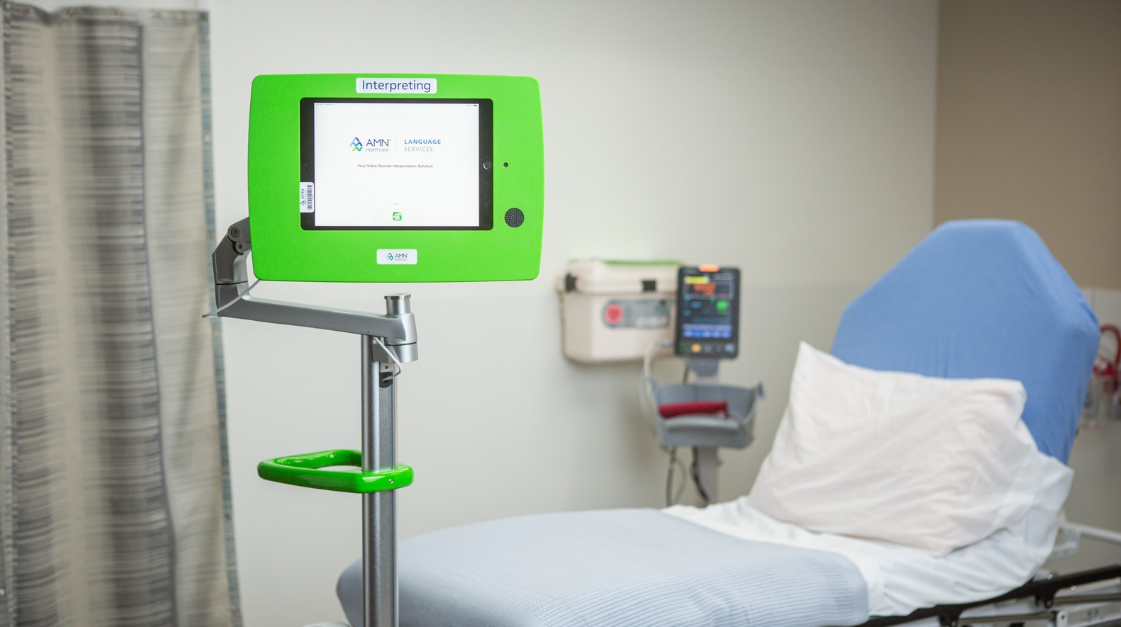
Central to this transformation was AMN's language services technology built specifically for healthcare. The deployment included 230 Video Remote Interpreting (VRI) devices strategically placed throughout the health system. Unlike generic platforms, these devices were engineered for the nuances of healthcare environments, providing consistently fast connectivity, even in low-bandwidth areas typical of busy clinical settings.
To address the reporting challenges experienced with the prior vendor, the solution emphasized data transparency from day one. The system was designed to deliver accurate, real-time analytics that reflected what clinicians actually experienced on the floor, eliminating the guesswork and frustration of conflicting reports.
Finally, AMN’s language services team prioritized enhanced support structures. Full-service support channels were made readily available, ensuring clinicians could quickly get help when needed. This reduced administrative burden and allowed providers to concentrate fully on patient care without worrying about language access disruptions.
Better Quality, Better Care
By prioritizing a quality-first approach, the health system experienced immediate, measurable improvements. The shift optimized resource allocation, streamlined clinical workflows, and drastically improved both patient and provider satisfaction.
The impact of these targeted enhancements was transformative. Average connection speeds for video remote interpreting cut in half across all languages: they dropped to just ~12 seconds across all languages.
Over-the-phone interpreting (OPI) was similarly efficient, with answer speeds averaging ~11 seconds system-wide. Connection reliability soared, as demonstrated by a 97% OPI rollover rate, ensuring calls connected smoothly without disruption. Session durations for VRI stabilized at 14.3 minutes, which signals that interpreters consistently had the time needed to support thorough, accurate medical conversations.
The health system achieved its primary goal: restoring confidence in its language access operations. Clinicians felt supported by the rapid response times, and leadership regained the ability to trust their operational data. Furthermore, an internal analysis revealed a significant drop in one-minute calls.
Explore the eBook

Tools for Healthcare Leaders: Building a Foundation of Trust and Quality
For healthcare executives navigating budget planning cycles and evaluating vendor partnerships, this case study offers several lessons.
One of the most significant takeaways for healthcare leaders is that true cost effectiveness comes from quality, not just initial cost savings. Attempts to trim budgets by working with non-specialized, discount vendors can lead to costly inefficiencies, which cause workflow disruption and a decline in overall staff productivity. Proven, healthcare-exclusive interpretation services, on the other hand, streamline communication, making it faster and easier for clinicians to do their jobs effectively.
Data transparency stands out as another non-negotiable requirement. Leadership teams must have access to real-time analytics that accurately reflect what is happening on the clinical front lines. Without data that matches clinicians’ lived experiences, it’s impossible to optimize operations or make informed decisions.
Just as important, healthcare-exclusive partners offer clear advantages. Medical language access demands specialized terminology, cultural sensitivity, and strict regulatory compliance. Vendors that dedicate their focus exclusively to healthcare understand these unique requirements and ensure their platforms, protocols, and training align with them.
Connection Data as Indicators
Finally, successful organizations pay close attention to connection data as a measure of system performance. A spike in incomplete connections or frequent sub-one-minute calls can be a warning sign that the solution is undermining staff confidence instead of supporting it.
For decision-makers, regularly monitoring these metrics helps identify problems early and provides proof when partnerships are working as intended.
By reinvesting in a quality-driven language services partnership, the health system successfully eliminated workflow bottlenecks, secured reliable reporting data, and most importantly, ensured equitable, compassionate care for every patient.
Ready to optimize your language access operations and improve patient care? Don't let poor vendor performance drain your resources and impede your staff. Connect with our team of healthcare language experts to discover how our real-time analytics and reliable interpretation solutions can streamline your workflows.
Contact Us