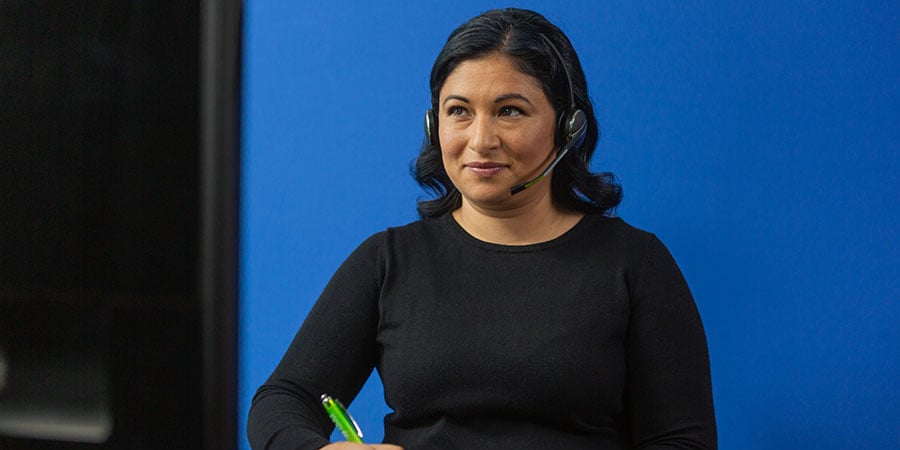


A Day in the Life of a Medical Interpreter
You can find plenty of pages that explain how to become a certified medical Interpreter. What you can find far less of is an honest answer to the question that comes right after: what is this job actually like on a Tuesday afternoon in month four?
This guide is for candidates who have already researched certifications and pay and are now trying to figure out whether the day-to-day reality fits their life. It covers all three modalities — over-the-phone (OPI), video remote (VRI), and in-Person — with the specific operational details that are often left out of most career content.
Over-the-Phone Interpreting (OPI): The Full Shift
Expected Workflow
OPI calls come in through a queue. You log in, set your status to available, and the first call connects — sometimes within seconds, sometimes after a short wait depending on the hour and your language pair. You have no advance information about the patient, the provider, or the encounter type before the call begins.
A typical OPI shift runs four to eight hours. Within that window, you might handle 15 to 35 calls depending on call length, your language pair's demand volume, and the time of day. Spanish interpreters working peak hours generally see higher volume. Interpreters working rare languages may have longer gaps between calls but more complex encounters when calls do come in. At AMN Healthcare, OPIs are contractors and choose when and how long they want to work.
Call length varies widely. A pharmacy clarification might run three minutes. A psychiatric intake or an oncology consultation can run 45 minutes or more. You rarely know which you're walking into until the provider starts speaking.
The cognitive shape of the day
Audio-only interpreting is more fatiguing than most candidates expect, and the fatigue is different from other kinds of mental work. You carry the entire communicative load of two people across a barrier you can't see. There's no body language to anchor meaning. Accents, poor phone connections, and patients under stress all compress your processing window.
By hour three or four of consecutive calling, most OPI interpreters notice a degradation in speed and a rise in effort. Experienced interpreters manage this by taking breaks between calls front-loading complex vocabulary review during slow periods, and staying aware of when they are working harder than usual so they can self-regulate scheduling.
Video Remote Interpreting (VRI): The Setup and the Screen
Technical environment
VRI adds a visual dimension to remote interpreting, which changes the job in meaningful ways. You work from a dedicated home office space — AMN provides equipment for active VRI interpreters — and you're visible on screen throughout the encounter.
The technical requirements are specific: a hardwired internet connection (no Wi-Fi), a HIPAA compliant space, interpreter background, proper lighting, and a camera setup that places your face at eye level. AMN's onboarding process walks you through exactly how to configure this. Before you go live on the platform, a technical check confirms your setup meets clinical standards.
What the screen shows you
In a VRI encounter, you typically see the patient and the clinical environment. This is more information than OPI gives you, and it changes interpretation in subtle but important ways. You can read expressions, track whether the patient is confused or distressed, and respond to nonverbal cues. You can also tell when a patient has stopped listening and the provider hasn't noticed yet.
That additional context makes VRI encounters feel more like in-person work than OPI does. It also raises the emotional stakes slightly — you are visually present in moments of vulnerability in a way that audio-only work doesn't replicate.
The hardest part of VRI for most new interpreters isn't the language — it's the emotional residue between calls. You finish a call where a patient just received a terminal diagnosis, you get 90 seconds of silence, and then the next call connects. You are expected to show up fully for that second encounter.
This is a skill that develops over time, and it's one that AMN Language Services actively supports through interpreter wellness resources and access to peer communities. But candidates should know going in that navigating vicarious trauma is part of the job, and it takes practice.
Scheduling patterns
VRI work at AMN is structured around scheduled shifts rather than open-queue availability. This gives interpreters more predictability but less flexibility than OPI queue work, which is a meaningful lifestyle difference for interpreters managing family schedules, other jobs, or long commutes. VRI interpreters work set hours with advance notice, which makes planning around the job easier.
Call volume per shift varies by language and time of day, but the shift structure means you're not waiting on an unpredictable queue — you know when your day starts and when it ends.
In-Person Interpreting: The Physical and Emotional Reality
Scheduling and logistics
In-person interpreting is appointment-based. You choose what sessions you interpret — from a list of hospital, clinic, or community health assignments— and you travel to each site. Assignments might be clustered in one facility or spread across multiple locations.
Transit and parking logistics are a real part of the job that often goes unmentioned. Urban in-person interpreters frequently build 15 to 30 minutes of travel buffer between appointments. A day that looks like five assignments on paper might involve two hours of transit.
AMN's in-person app helps with assignment matching and can enable you to cluster assignments geographically when possible.
The weight of physical presence
In-person interpreting places you inside the clinical encounter in a way that VRI and OPI do not. You are in the room when a patient learns something they were not prepared to learn. You are present for conversations that the patient and provider will remember for years.
This is what draws many interpreters to in-person work — the depth of connection and the sense that your presence made a hard moment more navigable for a real person. It is also arguably the most emotionally demanding modality over time.
Encounters that carry the highest weight are generally in emergency, oncology, mental health, pediatric, and end-of-life settings. Interpreters who specialize in these areas often develop decompression strategies.
What candidates underestimate
New in-person interpreters are often surprised by two things. First, the physical endurance required — a full day of assignments means being on your feet, moving between sites, and staying fully present through back-to-back encounters. Second, the silence after a particularly heavy assignment. You leave the room, get in your car, and drive to the next site. There's no built-in decompression. Building that in — a few minutes in the parking lot before you move — is a habit most experienced in-person interpreters develop on their own.
What Candidates Consistently Underestimate Across All Three Modalities
These aren't modality-specific. They come up across all three paths.
- Context switching. You move from a pediatric wellness visit to an oncology consultation to a mental health screening, sometimes within a single day of work. The content changes. The emotional register changes. You are expected to adjust completely each time, often with little transition.
- The vocabulary gap. Certification prepares you for medical terminology in general. Clinical environments are specific. The first time you interpret in a specialty you haven't prepared for — nephrology, neonatal, neurology — you will notice the vocabulary edges. Experienced interpreters keep running vocabulary lists by specialty, review before sessions when they have the information in advance and engage in continued learning throughout their career.
- The isolation of the role. Interpreting is structurally solitary. In OPI and VRI, you're alone in a room for hours. In-person, you're inside someone else's appointment, not part of a team in the traditional sense. Building professional community — through AMN's interpreter networks, through interpreter organization memberships, through peer connection — matters more for longevity in this career than most candidates anticipate.
Modality Fit: A Self-Assessment
There is no universally right modality. The better question is which one fits how you work, what your schedule allows, and what draws you to interpreting in the first place.
OPI may be the right fit if:
- You enjoy working for yourself and managing your own time
- You prefer working from home with flexible queue availability
- You're comfortable with audio-only work and can sustain focus without visual cues
- Your language other than English is one of lesser diffusion that may not be available over video
VRI may be the right fit if:
- You want the structure of scheduled shifts over open-queue availability
- You're comfortable with technology and can maintain a dedicated HIPAA compliant home office setup
- You prefer having visual context during encounters or your language pair requires it, i.e. ASL
- You want the feel of in-person work without the daily logistics of traveling between sites
In-person may be the right fit if:
- Physical presence and human connection are what drew you to interpreting
- You're based in or near a metro area with dense healthcare infrastructure
- You can manage appointment-based scheduling and the transit logistics that come with it
- You're prepared for the emotional weight that comes with being physically inside the room
Some AMN interpreters choose to work in more than one modality. Remote interpreters may add in-person sessions during gaps in their schedule. AMN's language operations teams can help you find a configuration that fits.

What AMN Support Looks Like in Practice
The specifics vary by modality and region, but a few things are consistent across AMN Language Services:
- Job matching — our recruiting team works to align your language pair, modality preferences, and scheduling needs with available work, rather than sending you into a generic queue
- Interpreter wellness resources — access to peer support networks and resources designed specifically for the emotional load of healthcare interpreting is available to employees
- Support network— interpreter managers are interpreters themselves with a vast understanding of the complexities of the profession