

How AI Workforce Planning Improves Hospital Fill-Rate Forecasting
Staffing decisions rarely wait for a perfect forecast, and your teams feel that pressure every shift. AI workforce planning for hospitals connects census, acuity, seasonality, and historical fill patterns into a single forecasting pipeline. That connection gives workforce planners and CNOs the data-driven confidence to act on staffing decisions days or weeks earlier than traditional models allow.
Why Reactive Staffing Models Fall Short
Most hospitals still build their staffing model around annual FTE budgets and static grids. Those tools were never designed to absorb daily census swings, mid-shift acuity changes, or seasonal volume surges.
That disconnect carries a real cost. According to the AHA 2026 Environmental Scan, each 1% change in RN turnover either costs or saves the average hospital $289,000 annually. When your planning cycle refreshes once a year but your census changes every four hours, the gap between what you budgeted and what you need widens quickly.
Traditional models also miss acuity-driven demand spikes. They overlook how unfilled shifts compound into overtime, agency reliance, and burnout for the people at the bedside.
That gap is also an opportunity. Rather than incremental fixes, you can move toward a fundamentally different operating model, one built to anticipate change instead of react to it.
How Predictive Modeling in Healthcare Turns Data Into Staffing Decisions
AI-driven workforce forecasting brings your data streams together to predict staffing requirements by unit, role, and shift. Those streams include patient census, acuity scores, ADT records, historical fill rates, seasonal patterns, time-and-attendance logs, and external labor market signals. When you integrate demand, labor supply, and budget data, workforce AI supports hiring forecasts 12 to 18 months in advance.
Peer-reviewed research supports this approach. An AI-driven HRM framework published in PMC integrates workforce demand forecasting, intelligent staff scheduling, and performance evaluation, drawing on historical admission trends, seasonal variations, and real-time census data. A narrative review of nursing demand forecasting models confirms that machine learning and hybrid approaches improve prediction accuracy. The models that deliver the most value incorporate dynamic factors such as patient acuity and unit-specific characteristics.
The key distinction is between predictive and prescriptive analytics. Predictive modeling in healthcare forecasts what is likely to happen, such as elevated ED volume next Tuesday or a night-shift fill-rate drop on a med-surg unit in three weeks. Prescriptive analytics recommends what to do about it. You might activate float pool coverage, open targeted per-diem shifts, or initiate agency requests before the gap disrupts care.
Some implementations report demand forecast accuracy exceeding 90%, though results vary by data maturity and integration depth.
From Fill-Rate History to Fill-Rate Forecast
You can improve shift fill rates by applying predictive analytics to historical fill patterns by unit, shift type, and season. This approach turns backward-looking data into forward-looking probability models. The platform identifies which shifts are likely to remain unfilled by role, skill, and time window. It then recommends float-pool, per-diem, or agency coverage before gaps reach the unit.
The metrics that matter are specific: forecast accuracy, shift fill rate, time to fill, unfilled-shift hours, and agency utilization.
AMN Healthcare clients have achieved a 94% RN fill rate and a 248% expansion of internal resource pools. These results show how fill-rate forecasting translates directly into measurable workforce KPIs, including those the AHA recommends tracking, such as time to fill, turnover rates, and labor costs per patient visit.
Acuity and Census as Real-Time Demand Signals
Real-time acuity and census data sharpen near-term staffing decisions. They shorten the lag between a demand change and your staffing response, so your teams get support when they need it.
Short-term forecasts guide daily adjustments, such as adding or redeploying staff within a shift window. Medium-term forecasts inform schedule builds and float pool sizing over 30-, 60-, and 90-day horizons.
Effective models account for patient admissions, occupancy, seasonal illness patterns, service-line growth, vacation patterns, recurring schedule gaps, and overtime spikes. Your scenario planning should also include external disruptions, such as epidemics, weather events, and regulatory changes.
How an AI Workforce Management Platform Unifies the Staffing Model
AMN Healthcare's technology, WorkWise™, brings workforce planning, predictive scheduling, vendor management, and candidate engagement together in one AI workforce management platform. WorkWise gives you real-time visibility across your entire talent ecosystem. It supports labor strategies that range from internal float pools to contingent and per-diem staffing.
WorkWise Workforce Intelligence moves beyond the backward-looking dashboard model to help your organization understand current workforce conditions, anticipate future needs, and identify where action may be needed. The focus is broader than whether a shift was filled: it connects forecasting, scenario planning, workforce capacity, labor-cost intelligence, and workforce stability to support more proactive planning.
Through strategic technology partnerships, WorkWise integrates with your existing scheduling and operational tools. Your teams can keep working in familiar systems while gaining a clearer view of demand.
The outcomes are measurable. WorkWise has cut overtime hours by 27% and delivered up to $14M in annual savings within a year. Clients using AMN Healthcare's workforce analytics have achieved $18M in cost savings, a $300K reduction in overtime costs per pay period, and a 62.9% drop in turnover rates.
This is AI workforce management at work: forecasting, scheduling, and labor strategy operating from a single connected platform. The value goes beyond cutting costs. It creates steadier teams and better-supported care.
WorkWise Client Outcomes
- $6M savings driven by a more efficient staffing model
- 62.9% drop in turnover rates
- $300K reduction in overtime per pay period with a 94% RN fill rate
What Earlier, More Confident Staffing Actions Look Like
When AI workforce planning is part of daily operations, the results reach well beyond dashboards.
One health system saved more than $170 million annually with an 82% decrease in agency spend. It reduced external travelers by 75% and strengthened workforce stability by converting more than 200 staff to permanent roles. Temple Health achieved a $300,000 overtime cost reduction per pay period while maintaining a 94% RN fill rate.
The benefits look different for each leader:
- For your workforce planners: fewer last-minute scrambles.
- For your CNOs: better-staffed units and reduced burnout risk.
- For your finance leaders: defensible labor-spend decisions grounded in data.
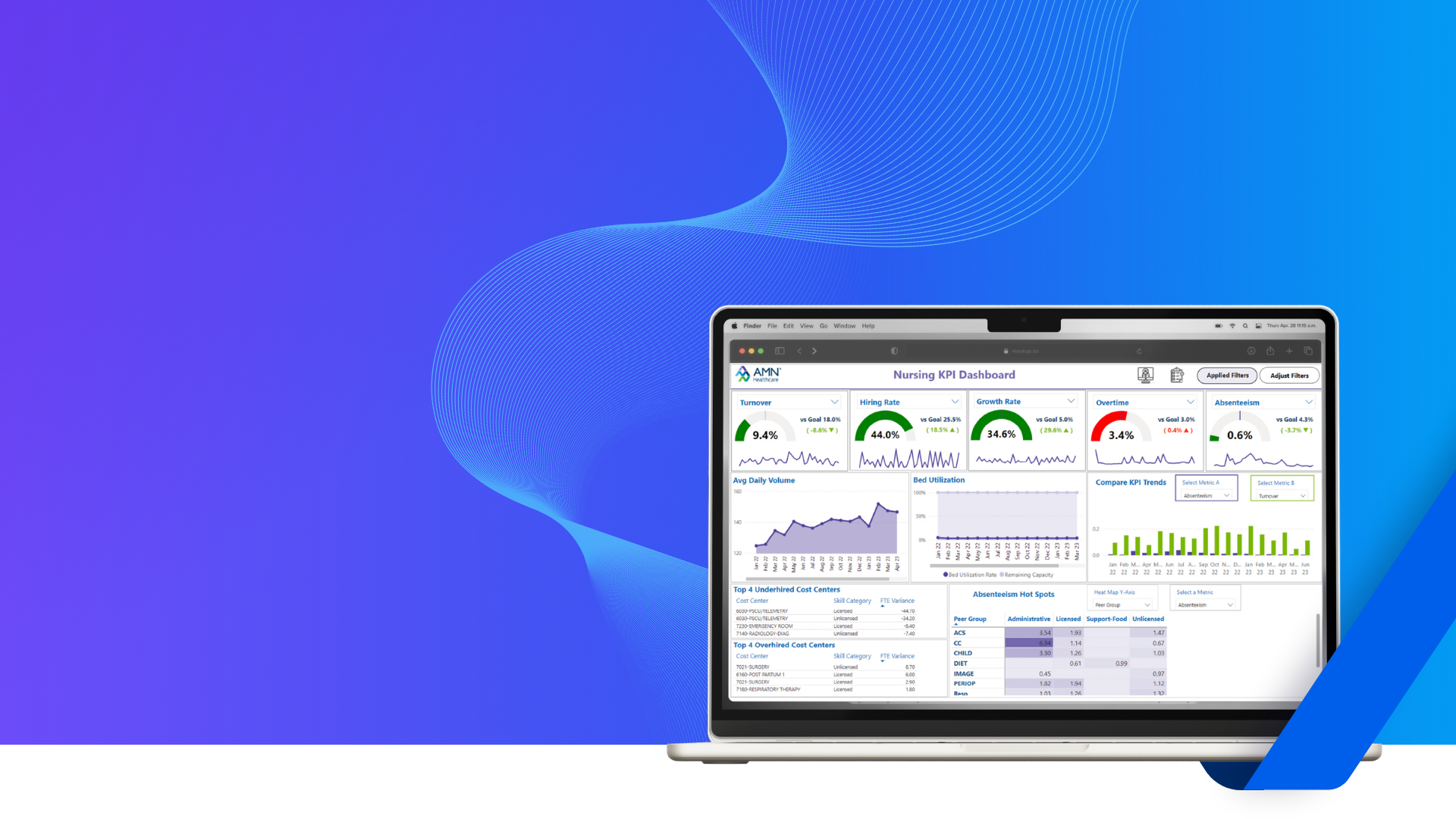
See how WorkWise fits into your existing workforce environment. You may be evaluating your first AI workforce management platform or looking to consolidate fragmented systems. Either way, we work alongside you to connect your workforce data to earlier, more confident staffing actions, at a pace that fits your priorities. Request a demo or explore the Workforce Planning Dashboard.
Frequently Asked Questions
Q: How does AI predict hospital staffing needs?
A: Workforce AI processes historical census, acuity scores, seasonal patterns, and ADT data to forecast demand by unit, role, and shift. When you integrate it with labor supply and budget data, these models support hiring forecasts 12 to 18 months in advance.
Q: How can hospitals improve shift fill rates?
A: Predictive fill-rate modeling identifies shifts likely to remain unfilled by unit, role, and skill. It then recommends float-pool, per-diem, or agency coverage before gaps reach the bedside. AMN Healthcare clients have achieved a 94% RN fill rate through this analytics-driven approach.
Q: What is the difference between predictive and prescriptive workforce analytics?
A: Predictive analytics forecasts what is likely to happen, such as elevated ED demand next week. Prescriptive analytics recommends the staffing action to take in response, such as adding float coverage or opening targeted per-diem shifts.
Q: What data is needed for healthcare workforce forecasting?
A: Effective forecasting draws on patient census, acuity scores, historical fill rates, ADT data, seasonal patterns, time-and-attendance records, overtime and agency usage, and external labor market signals.
Q: How far in advance can hospitals forecast hiring needs?
A: When you integrate demand, labor supply, and budget data into a connected workforce planning platform, you can support hiring forecasts 12 to 18 months in advance.