
The Pitt Season 1 and the Reality of Language Services in Healthcare
In emergency medicine, the most critical tool often isn’t a scalpel or a defibrillator. The ability to understand and be understood can make all the difference. When we fail to communicate, we jeopardize patient safety, delay diagnoses, and risk losing the reassurance that defines compassionate care.
Patients with Limited English Proficiency (LEP) frequently enter the emergency room facing unknown procedures and unanswered questions. Season 1 of The Pitt vividly portrays this reality, providing a window into high-stakes environments where language access shapes the course of care. Similar scenarios happen daily in hospitals worldwide, where medical interpreters transform confusion into clarity.
Season 1 of The Pitt presents a storyline that resonates with everyone involved in healthcare access. The medical team in The Pitt encounters a severe trauma case: Minu, a woman whom rescuers pull from subway tracks just before a train arrives. She arrives in the emergency department with a severe lower leg injury and her life on the line.
The trauma team acts quickly to stabilize her, but they immediately face a new challenge—they cannot communicate with her. The clinicians struggle to assess her situation: Was this an accident? A suicide attempt? Is she in pain? Does she have allergies? The chaotic trauma bay grows even more intense amid lack of understanding.
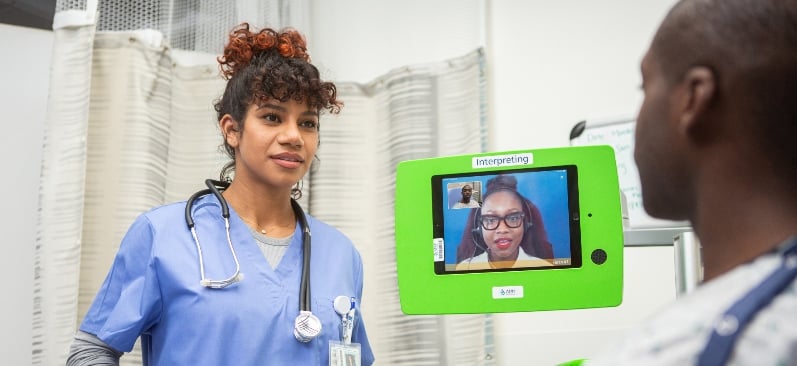
When the team discovers the language that Minu speaks, they immediately deploy an AMN Healthcare Language Services Video Remote Interpreting (VRI) device, connecting instantly with a qualified medical interpreter.
This decision changes the scene. The VRI unit shifts the experience from terrifying interventions to genuine conversation. Now, clinicians can explain upcoming steps and demystify the processes Minu faces. More importantly, Minu can finally speak for herself. The interpreter becomes the link, enabling the team to provide medical stabilization and reassurance.
This storyline reveals a fundamental truth of modern medicine: clear communication drives clinical excellence. Without the AMN Language Services' device, the team could only treat Minu’s injuries; with it, they could care for her as a person.
Beyond the Script: Real Stories from the Frontlines
While The Pitt portrays these moments on screen, our interpreters encounter them daily. They serve as unseen partners, navigating medical terminology and emotional stakes, to guarantee equity in care.
A Lifeline for New Parents
Kalliopi, a Greek medical interpreter, knows that medical interpretation goes far beyond translating words. It’s about easing fear. She recalls helping a family whose newborn was in critical condition:
In the Neonatal Intensive Care Unit (NICU), every monitor beep can set parents on edge. For those who don’t speak the dominant language, isolation intensifies their anxiety. Kalliopi’s work extended past literal translation; she connected the family with the medical team’s expertise and provided hope. By breaking the language barrier, she enabled doctors to deliver important updates and helped the parents understand their child’s care plan.
In those moments, Kalliopi empowered the family to act as parents rather than bystanders, allowing them to ask questions and advocate for their child.
The Comfort of Connection
Medical situations can make patients feel vulnerable. Oksana, a Russian and Ukrainian interpreter, shares how her presence helped a patient feel more comfortable in the clinical setting:
She supported a patient who told her that having Oksana in the room brought comfort and reassurance. When patients feel understood, their anxiety decreases, they provide more complete medical histories, follow instructions closely, and trust their providers.
Oksana’s contribution reaches far beyond language conversion. She transforms unfamiliar environments into spaces of psychological safety and offers patients the security of having a true voice during their care.
The ROI of Empathy and Access
The contrast between Minu’s fictional emergency and the real-life experiences of Kalliopi and Oksana teaches a lesson: language services are essential to operations, not optional.
When we provide seamless language access, whether through VRI, phone, or in-person interpreters, we optimize every step of the care pathway.
- We reduce medical errors: We collect accurate histories and prevent dangerous mix-ups and misdiagnoses.
- We improve efficiency: As The Pitt demonstrates, direct interpreter access means teams spend less time guessing and more time treating.
- We restore dignity: Every patient deserves to understand what’s happening to their body.
Looking Ahead
As we continue to champion health equity, stories like these remind us of the ongoing work required. Season 2 of The Pitt arrives January 8, 2026, promising to further develop these themes.
Everyone needs healthcare, but each person’s language is unique. By bridging those language gaps, we can truly heal people.
Looking to care for all patients regardless of their spoken language? Connect with us to learn how our language services can help.