

Closing the Language Gap in Pediatric Care: Children's Hospital Los Angeles and AMN Healthcare's Jaide AI
For millions of families across the United States, a hospital visit can end with a stack of paperwork they cannot read. Discharge instructions, medication schedules, and follow-up care plans arrive in English, even when English is not the language spoken at home. For families with limited English proficiency (LEP), that gap can mean confusion at a moment when clarity matters most.
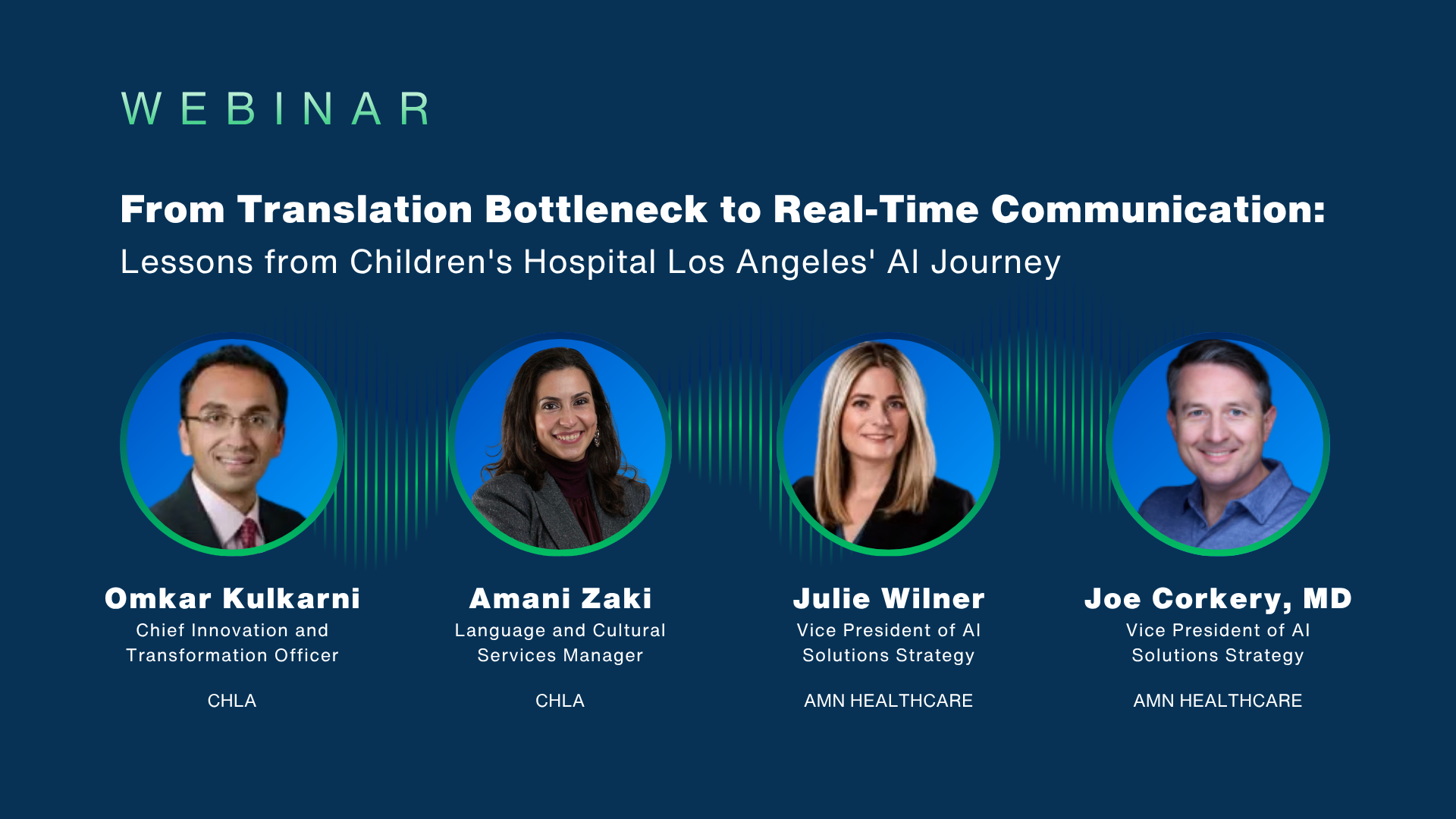
A recent Becker's Healthcare webinar, "From Translation Bottleneck to Real-Time Communication: Lessons from Children's Hospital Los Angeles' AI Journey," brought together the people who are closing that gap. The panel included Omkar Kulkarni, Chief Innovation and Transformation Officer at CHLA; Amani Zaki, Language and Cultural Services Manager at CHLA; Julie Wilner, Vice President of AI Solutions and Operations at AMN Healthcare Language Services; and Dr. Joe Corkery, MD, Vice President of AI Solutions Strategy at AMN Healthcare Language Services. Moderated by Lucas Voss of Becker's Healthcare, the conversation traced how one children's hospital system moved from a translation bottleneck to a workflow that keeps pace with mounting patient needs.
Their story offers a clear framework for any health system weighing how to extend language access without overextending its staff. You can watch the webinar on-demand here, or continue reading for the recap.
How Language Barriers Affect Children in Health Care
CHLA's service area includes more than two million children, and Kulkarni noted that close to half of the hospital's patients speak a language other than English at home, whether as their only language or alongside English. CHLA serves more than 750,000 patient visits a year across 385 beds, a volume that makes manual translation difficult to sustain, especially on the outpatient side.
Before adopting AI-assisted translation, CHLA's in-person language team manually translated discharge instructions for inpatients. Outpatient visits, which occur in far greater volume, had no equivalent process at all. Zaki, who leads a team of 32 language and cultural services professionals, one of the largest such departments in the country, described this as a persistent gap. Even a well-staffed department could not keep pace with the volume of outpatient encounters that needed same-day translated materials.
For hospitals with smaller language teams or no in-house interpreters, the same math is even more unforgiving. Without a scalable solution, LEP families face longer wait times for translated materials, lower adherence to care instructions, and a higher likelihood of returning to the hospital for issues that clear communication could have prevented.
Why Does Language Access Matter So Much in Pediatric Settings?
Kulkarni framed the stakes plainly: children cannot advocate for themselves, and their parents cannot advocate effectively without a clear understanding of what the care team is asking of them. "It's hard to understand your instructions if they're not in the language that you're comfortable speaking," he said during the panel.
This directly connects to compliance considerations under Title VI and state language access laws, but the panel's emphasis stayed grounded in outcomes, not regulation alone. Corkery pointed to a core logic that runs through the entire conversation: when people understand their instructions, they are more likely to follow them, and when they follow them, they are more likely to recover well. That chain directly connects language access to readmission rates, length of stay, and quality of care.
Kulkarni shared a personal story: While traveling in Asia, he took his sick child to an urgent care clinic where staff provided excellent care. Thankfully the discharge instructions were in English, even though many other languages were being spoken. He described the situation, “I could not imagine what would have happened had they given me instructions in a language that I did not speak with my child there...this is table stakes. People need to understand what they're being asked to do in a language that makes sense to them."
Shared Successes: CHLA and Jaide AI
CHLA began piloting Jaide AI, AMN Healthcare's AI-powered translation tool, in early 2025. Rather than mandating the technology, Kulkarni's team introduced it to Zaki's department as an option, inviting feedback at every stage. That decision shaped everything that followed.
Zaki's team found that discharge instructions taking an hour and a half to two hours to translate manually were completed in about 25 minutes using Jaide. That time savings freed interpreters to handle more live interpreting sessions and gave the hospital a way to produce outpatient and ambulatory discharge summaries in a patient's preferred language on the day of the visit, something that was not possible before.
Wilner, a registered nurse by background who co-founded Jaide after years at Google, described how her team built the tool around the realities of CHLA's workflow. Interpreters had previously walked from the bedside to a separate office to spend 90 or more minutes producing written translations. The redesigned workflow lets interpreters stay on the unit, process discharge documents at the nurse's station, and remain available for quick consultations, reducing discharge bottlenecks and getting patients home sooner.
Wilner noted that CHLA's more than 30 interpreters were initially skeptical of an AI tool handling work tied so closely to patient safety. The team addressed that skepticism by starting with retroactive testing against past data, rolling out access as opt-in, and incorporating interpreter feedback directly into the tool before any live patient data was involved. Adoption grew from a handful of early testers to what Zaki now describes as full staff support.
How Human Review Keeps the Process Safe
CHLA's governance approach focused on validating output quality before going live. The team selected a diverse set of discharge instructions, had Zaki's linguists score the translations against established criteria, and shared results transparently across hospital leadership. That process built internal confidence because Jaide's output met or exceeded the quality of manual translation.
Ongoing governance did not stop at launch. Zaki's team regularly audits a sample of translations, evaluating grammar, accents, spelling, and linguistic accuracy at a granular level, using a rubric developed by a member of her team. An AI governance group at CHLA reviews accuracy at a broader level on an ongoing basis.
Kulkarni emphasized that Jaide-generated translations never replace the original English instructions. Patients and families receive both versions, with clear disclosure that the translated version was AI-generated. He compared the approach to how a search engine pairs an AI summary with the underlying search results beneath it: families who want to verify details against the English original always have that option.
Practical Lessons for Other Health Systems
CHLA's experience offers a framework that other hospitals can adapt, regardless of team size:
- Start narrow. CHLA began with inpatient discharge instructions because delays there had a direct, visible effect on discharge timing. A focused initial rollout builds trust before expanding.
- Treat vendors as partners. The hospitals getting the most value from AI tools are those that collaborate with vendors to shape a solution together, rather than simply purchasing a product.
- Measure before and after. Define what success looks like before launch, and confirm you can capture the relevant data. That often requires a senior sponsor who can connect clinical, IT, and language services teams.
- Plan for hybrid review. Hospitals without large in-house language teams can still access human review of AI-generated translations through AMN Healthcare's model, making the approach viable at different scales.
What Comes Next
The panel pointed to several directions shaping the next phase of this work. CHLA is extending Jaide to translate messages between patients and care teams through the patient portal. Kulkarni also raised the challenge of health literacy: many patients, including English speakers, struggle with instructions written above their reading level. The next step may involve adjusting reading level alongside language. Wilner noted growing interest in extending similar approaches to support Deaf and Hard of Hearing patients.
The Bottom Line
Language access is a direct line to patient safety, family trust, and care outcomes. CHLA's experience shows that closing the gap does not require choosing between human expertise and new technology. AI handles volume and speed; trained linguists provide the judgment that safety-critical communication demands.
For health systems ready to take that step, AMN Healthcare brings 40 years of healthcare-exclusive language services experience, paired with Jaide AI's human-reviewed translation technology, to help hospitals meet every patient in the language that works for them. Fill out a form to connect with us today.