
Beyond the Screen: Lessons on Language Access From The Pitt
Media has a powerful role in shaping public understanding of complex issues. When a major television series like HBO's The Pitt dedicates screen time to the realities of language access in healthcare, it moves a critical conversation into the mainstream. Following its thoughtful representation in the first season, the show’s second season continues to explore these challenges with nuance and accuracy. We commend the producers for their commitment to portraying the authentic communication barriers facing patients and providers.
The series highlights how gaps in communication can escalate risk and affect patient outcomes. As an organization at the forefront of language services, we see these scenarios play out in real healthcare settings. The show's depiction of strained workflows, inconsistent interpreter use, and the pressure on clinical teams reflects real operational challenges. Here is what we are seeing in the field compared to the show's portrayal.
The On-Screen Experience
For many of our qualified medical interpreters, watching the recent episodes of The Pitt was an uncomfortable but validating experience. The storyline featuring a Deaf patient navigating the emergency department captured the gap that can exist between the established standard of care and the patient's actual experience. Let’s walk through the episodes and examine the language access challenges step by step, along with evidence-based solutions that transform care:
Scene: Check-in and Waiting Room
Problem:
The deaf patient arrives at the ER and indicates a need for an ASL interpreter on her paperwork. The front desk staff, overwhelmed by volume, misses this request. As a result, she waits for hours without her communication needs being addressed.
Solution:
This is a critical breakdown seen far too often in the real world. Having a clear language access workflow in place at the front desk could have changed the outcome entirely. We’ve seen that the most successful health systems are equipped with efficient processes for identifying language needs right at check-in. Best-in-class systems have language access technology set-up at the front desk so clear communication can start immediately. Interpreter requests should be initiated upon receipt so that support is ready when the patient is called.
Scene: Initial Clinical Encounter
Problem:
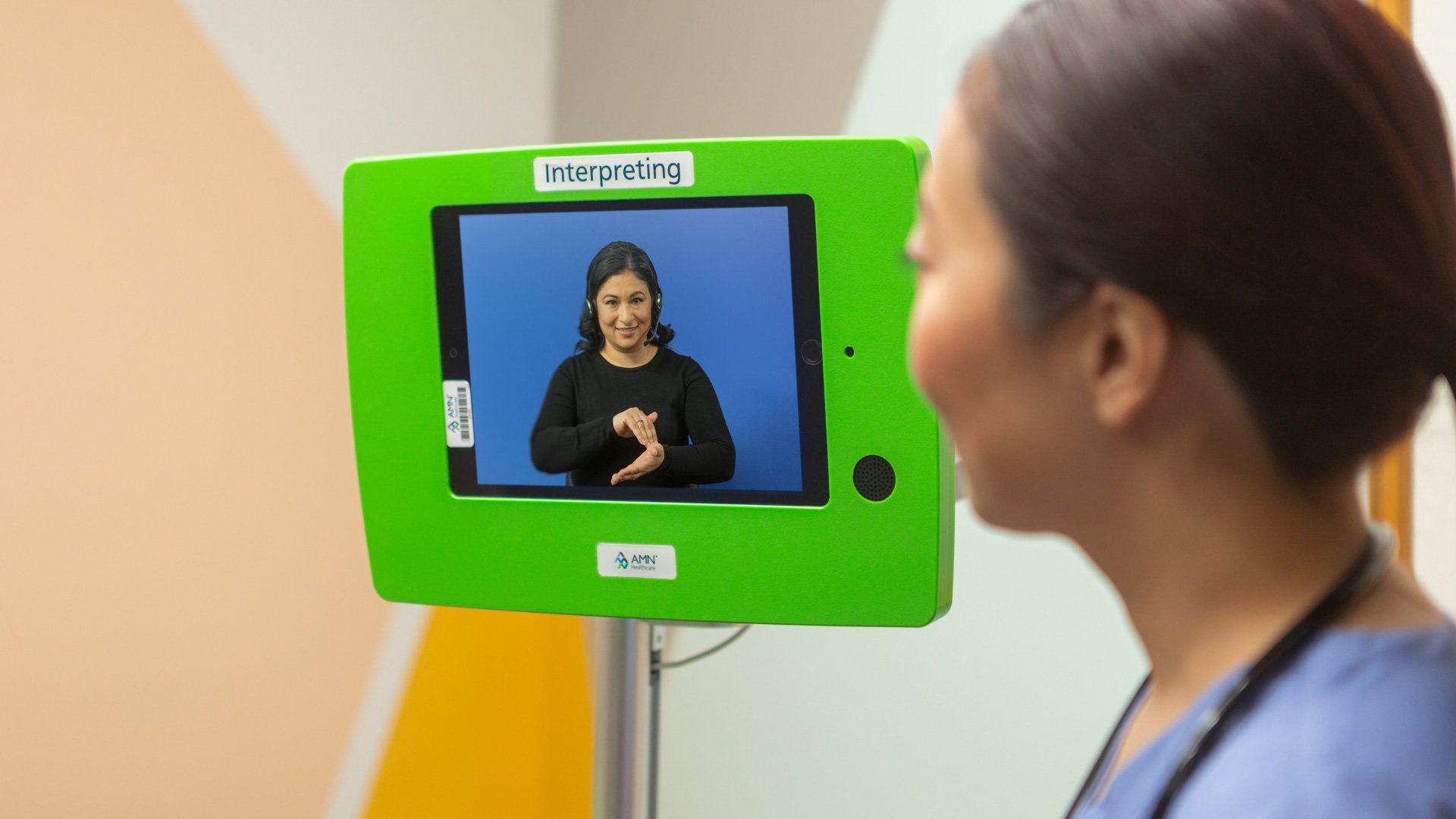
With the Video Remote Interpreting (VRI) device otherwise occupied, a nurse attempts to use basic sign language but is unable to accurately understand the patient's symptoms. The clinical team, unable to communicate, eventually disengages, leaving the patient unsupported.
Solution:
Clinical staff should use any available tools, such as written communication, text-based devices, or even typing on smartphones, to gather key information while waiting for a qualified interpreter. Maintaining presence at the bedside and showing the patient that their needs are being prioritized establishes trust, even before specialized language services arrive.
The need to resort to such methods can be avoided if a health system has a sufficient volume of language access devices to handle contingencies. Onvida Health faced a similar challenge and tackled delays in accessing VRI devices by increasing their inventory, strategically distributing them across the system, and optimizing workflows with built-in redundancies. This streamlined approach ensures devices are always accessible, and Onvida Health reduced their connection times for patients with limited English proficiency (LEP) by 15 minutes. The result: faster care and improved patient satisfaction. Download the full Onvida Health case study to learn more.
Scene: Attempted Video Remote Interpreting (VRI) Support
Problem:
A VRI device is introduced, but it freezes and remains unusable. There is no troubleshooting or backup plan, leaving the patient further frustrated and isolated.
Solution:
Cutting-edge technology alone is not enough. It must be paired with proactive operational workflows. Ensure VRI equipment is reliable, with backup devices and clear troubleshooting steps available. Staff should be trained to quickly switch to alternative communication tools (written notes, type-back features, or other devices) if VRI fails to minimize disruption to care.
Our recent Fortune 100 client faced the challenge of standardizing quality language services across 165 hospitals and hundreds of outpatient settings. Their goal was to consolidate vendors and implement a consistent, scalable solution.
To empower clinicians at the point of care, we helped the health system equip its nurses and providers with iPhones that have our interpreting app built directly into their workflow. This ensures there are always language access resources at hand, even when a specific device or cart is unavailable.
Scene: In-Person Interpreter (IPI) Arrival
Problem:
An in-person interpreter arrives, but the provider engages exclusively with the interpreter, not the patient. Care is further delayed as the interpreter focuses on establishing rapport with the patient while the provider moves on.
Solution:
Interpreters are trained to facilitate a triadic relationship, bridging communication between patients and providers so that both are included. Providers should make eye contact and speak directly to the patient, letting the interpreter facilitate but not replace that connection. Ongoing education for providers about best practices in interpreter-mediated care strengthens this relationship.
A robust language services program doesn’t rely solely on a single solution. Instead, leading organizations invest in a diversified portfolio—incorporating In-Person Interpretation (IPI), Video Remote Interpreting (VRI), and Over-the-Phone Interpretation (OPI)—with enough devices and staff to ensure reliable access, even if one option becomes unavailable.
One of our partners is a good example of how to strengthen an IPI program to ensure ample language access coverage for their patients. Besides building their IPI program, their solution increased their interpreter fulfillment rate while reducing interpreter costs. Read the case study and learn how they achieved their success.
Diversifying Solutions for Consistent Care
The storylines in The Pitt reflect the importance of language and communication as core drivers of health. When communication is fragmented, care becomes fragmented. The patient's experience is improved when all elements (efficient check-in, reliable technology, and skilled interpreters) come together.
Building language access into clinical workflows is fundamental to patient safety, health equity, and operational excellence. When communication is designed to support care, rather than being a reactive addition, patient safety improves, staff feel better supported, and care moves forward, even under the pressures of a busy hospital.
If you’re interested in learning more about language access solutions seen on The Pitt and in other health systems across the U.S., , we invite you to submit a form to start the conversation with one of our knowledgeable team members. Our experts are ready to support your organization’s journey toward better communication and patient care.